FREE sourcing support and up to 3% coordination support. Eligibility applies to qualified business buyers and is confirmed after we review your product, quantity, destination, and sourcing requirements.
Material applications
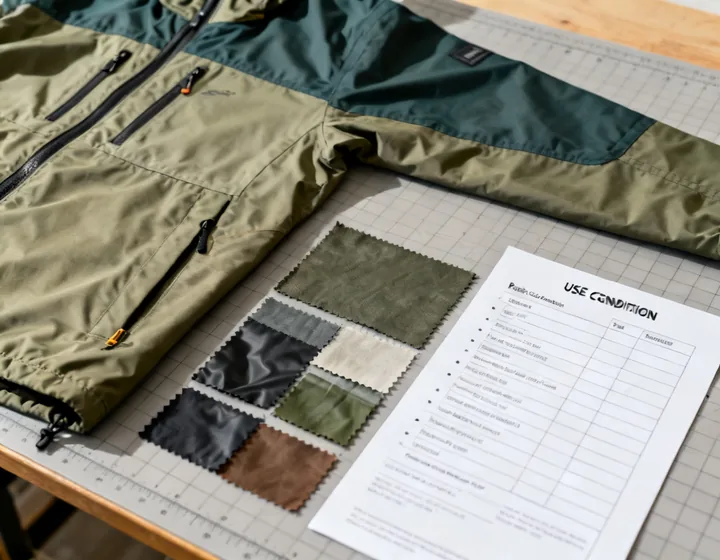
This supporting page does not introduce a new measured query. It translates a project use into purchase fields so outdoor and protective textiles are not quoted as interchangeable greige.
Record whether the cloth sits next to skin, over insulation, on a pack body, on a work garment or in an industrial cover. Note rain, snow, UV, abrasion against rock or machinery, repeated laundry, and heat from bonding or seam tape. Soft-shell stretch and laminated rainwear fail for different reasons; naming only “outdoor fabric” hides those gates. If the cutter needs a stable usable width after finishing, write the finished width, not the loom width. Site constraints such as bonded seam equipment, needle type and marker efficiency belong in the brief because they change which constructions are even sewable.
Water resistance, breathability, UV, abrasion, tear and colorfastness only compare when method, edition, specimen, conditioning and wet-or-dry state match. A mill citing a method title without a number, laboratory and date has not yet given a product result. Ask whether the tested piece is greige, dyed, coated or laminated, because finishing can move GSM and hand. Keep unknown targets open rather than copying a catalog claim from an unrelated article.
Seasonal apparel programs, industrial covers and equipment runs use different quantity units and shade-lot policies. State yards, meters, kilograms or rolls, pieces per color, and whether leftover trial lots may mix into bulk. Finish, DWR, coating or lamination should be priced as stages when they are optional. Delivery windows stay requests, not promises. Documents for labeling, fiber content and destination entry should be listed as questions for qualified parties, not as credentials of this sourcing desk.
Stock fabric can shorten sampling when the existing construction already meets fiber composition, GSM and usable width; custom development can align weave, gauge, membrane or finish but requires written minimums, lab dips and bulk lots. A headline unit price can look attractive until yield, testing, packing and US inland freight are added; comparable total cost uses the same width, weight, inspection and destination basis. Family claims for hydrostatic pressure or moisture vapor transmission do not replace an article-specific report with method edition year, laboratory and specimen state. Limits remain: this desk does not certify finished-goods labeling, does not convert greige in-house, and cannot treat an undated mill catalog as a 2017-or-later test result.
Include end use, exposure, test basis, quantity unit and the US destination so mill options can be filtered before sampling.
Qualified business buyers may receive FREE sourcing support and up to 3% coordination support. Eligibility applies to qualified business buyers and is confirmed after we review your product, quantity, destination, and sourcing requirements.
This is independent matching support. Eligibility is reviewed against the written brief; it is not a standing commercial concession or a timed offer.