
01 Clarify the brief
Lock end use, fiber mix, GSM window, usable width and finish before mill outreach. Mark every unknown so later alternatives can be scored against the same list.
FREE sourcing support and up to 3% coordination support. Eligibility applies to qualified business buyers and is confirmed after we review your product, quantity, destination, and sourcing requirements.
Independent textile sourcing partner
SwatchMeadow Procurement helps US business buyers turn a schoeller mention into a written outdoor and performance fabric brief. We match mills for composition, construction, GSM, usable width and finish, then collect factory quotations. We do not sell branded inventory, claim authorization, or treat a search term as proof of equivalence.
Send a fabric brief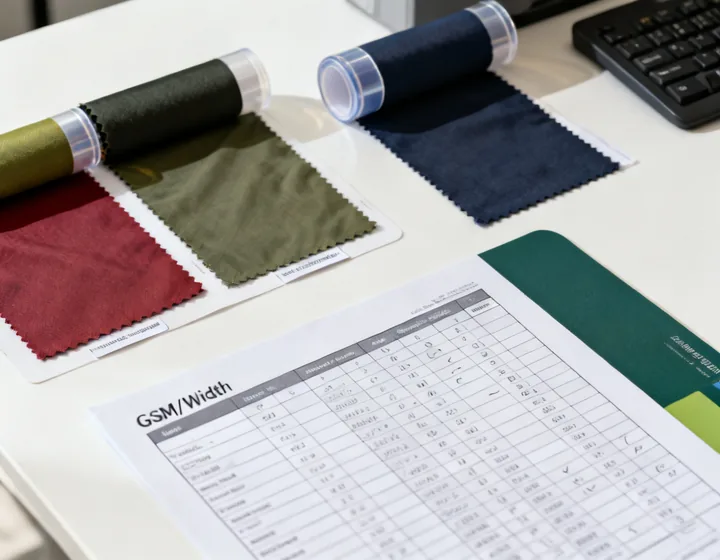
Start from the job the fabric must do, not from a marketing family name. Outdoor shells, laminated membranes, water-resistant weaves and industrial protective cloths need different GSM, finish and evidence. Open inquiry configurations only after the reference and unit of quantity are written down.
Composition, construction, GSM, usable width, finish, quantity and destination belong on the first page of the request. Write fiber composition as percent by fiber, fabric weight in g/m² or oz/yd² with a tolerance, and usable width in cm or in after finishing, excluding selvage unless agreed. Add color reference identity, shade-lot policy, roll length, water and breathability test basis, UV expectation and whether greige, dyed, coated or laminated goods are in scope. Leave unknown fields visible instead of inventing a mill value. A supplier can only quote what is measurable; a color story without a retained swatch is not an approval.
State quantity per color and the total with yards, meters, kilograms or rolls. Name the US destination and the sample path you will accept: stock swatch, lab dip, strike-off or pre-production panel. Ask for an article-specific data sheet tied to the quoted cloth, not a generic mill brochure. Optional budget should name currency and whether the figure is per yard or for the whole order.
Each handoff is a recorded decision, not a promised calendar. Outdoor programs often fail when a lab dip is treated as bulk shade or when a laminated swatch is assumed to survive a later bonding change.
Lock end use, fiber mix, GSM window, usable width and finish before mill outreach. Mark every unknown so later alternatives can be scored against the same list.
Request quotations on identical inclusions: yarn, weaving or knitting, dyeing, coating, inspection, packing, inland freight and export terms. Record exceptions in writing.
Identify the physical piece, date, reviewer and allowed deviation. A retained swatch screens hand; a lab dip addresses color; neither automatically represents the bulk dye lot.
Agree sampling, shade continuity, defect rules and which party books inspection. Bind every lab result to method, edition, specimen, conditioning, date and article code.
Outdoor apparel, pack cloth, awning-adjacent performance weaves and industrial protective textiles expose fabric to rain, abrasion, heat load and repeated laundering in different combinations. Name the contact surface, sewing route and expected service environment before ranking mill options.
Store material identity, revision, date and who signed. Do not treat a mill certificate hanging on a website as proof for the quoted article.
Lot, method and acceptance agreement stay order-specific. OEKO-TEX, GOTS, GRS or ISO papers, if requested, must show issuer, scope, site and exact-article connection.
State material, quantity and destination so factory quotes can be lined up on one specification.
Send a fabric briefQualified business buyers may receive FREE sourcing support and up to 3% coordination support. Eligibility applies to qualified business buyers and is confirmed after we review your product, quantity, destination, and sourcing requirements.
This is independent matching support. Eligibility is reviewed against the written brief; it is not a standing commercial concession or a timed offer.